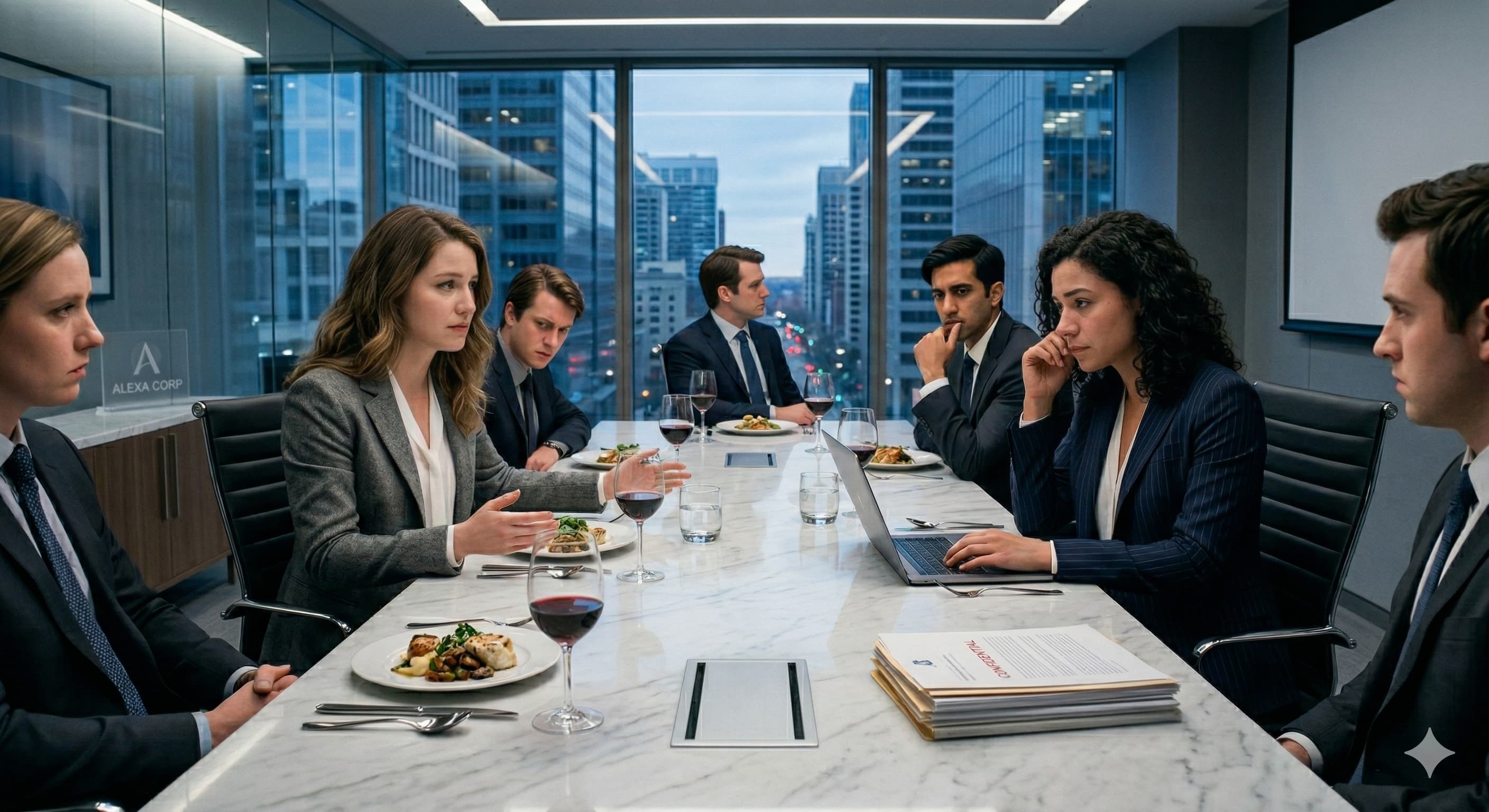

A Corporate Wellness Reflection
Meeting culture and workplace wellness are more connected than most organizations realize. Meetings are often treated as neutral containers a place to align, decide, and move work forward.
A place to align.
A place to decide.
A place to move work forward.
But over time, meetings become something else entirely. They become the most repeated environment in a person’s work life and one of the most revealing.
Not because of what’s discussed, but because of how people are expected to show up.
What is meeting culture in the workplace?
In many organizations, meetings move quickly by default.
Agendas are full.
Time is compressed.
Silence is interpreted as inefficiency.
The expectation is rarely stated outright, but it’s learned quickly: keep things moving.
People speak before they’ve fully formed a thought.
Questions are softened or skipped.
Concerns are noted “offline.”
The goal becomes momentum not understanding.
Over time, this pace reshapes how people participate. Meetings stop being places where thinking happens and become places where thinking is performed.
The Invisible Labor Inside the Room
What rarely gets acknowledged is how much regulation happens inside meetings.
People manage tone.
They suppress irritation.
They track reactions.
They decide often in real time what is safe to say and what is not.
This emotional and cognitive labor doesn’t show up in notes or action items, but it accumulates.
Especially for those who:
Hold responsibility without authority
Carry relational or people-facing roles
Sit at intersections of power or difference
For them, meetings aren’t just about content. They’re about containment.
When Silence Stops Meaning Thoughtfulness
Silence in meetings is often misread.
Instead of being seen as reflection, it’s treated as disengagement.
Instead of curiosity, it’s treated as hesitation.
So people learn to fill the space.
They offer partial agreement.
They nod instead of questioning.
They defer instead of clarifying.
Not because they have nothing to contribute—but because the environment doesn’t support pause.
The cost of this is subtle but significant: decisions are made without the full intelligence of the room.
The Long-Term Consequences of Constant Motion
Meetings that never pause don’t just exhaust people in the moment. They shape culture over time.
People stop bringing nuance.
They stop raising early concerns.
They stop trusting meetings as places where complexity is welcome.
Instead, complexity goes underground.
It shows up later as:
Rework
Misalignment
Quiet resistance
Decision fatigue
And eventually, disengagement.
This isn’t because people don’t care. It’s because the structure doesn’t allow them to care fully.
Why This Becomes a Wellness Issue
Corporate wellness is often discussed as something separate from “how work gets done.”
But meetings are work.
They shape:
Attention
Energy
Psychological safety
A person’s sense of belonging
When meetings require constant alertness without relief, people leave them tense instead of clear.
One meeting may not matter.
Five meetings a day, every day, do.
This is how exhaustion becomes normalized—not through crisis, but through repetition.
The Pressure to Appear Clear
One of the most overlooked dynamics in meetings is the pressure to appear certain.
Uncertainty slows things down.
Clarifying questions interrupt flow.
Naming doubt feels risky.
So people present ideas as more resolved than they are. Leaders receive apparent alignment—until reality proves otherwise.
This creates a feedback loop:
Leaders move faster, believing clarity exists
Teams hesitate more, believing pause is unwelcome
Trust erodes quietly, not because intentions are poor, but because pace outpaces understanding.
What Gets Lost When Meetings Don’t Pause
When there is no room to slow down, organizations lose access to:
Foresight
Creativity
Dissent that could prevent mistakes
Honest engagement
People don’t disengage because they don’t care.
They disengage because caring requires space.
Meetings that never pause train people to conserve energy instead of contribute insight.
The Quiet Realization
At some point, many organizations notice symptoms:
Meetings feel unproductive
Decisions don’t stick
People appear present but disconnected
The temptation is to optimize:
Shorter meetings
Tighter agendas
More facilitation tools
But optimization alone doesn’t address the underlying issue.
The issue isn’t time management.
It’s what the pace of meetings communicates about what—and who—matters.
Where SUUM Enters the Conversation
SUUM does not exist to redesign meetings.
It exists to name what gets overlooked when work moves faster than people can integrate.
When meetings never pause, it’s not because people lack discipline.
It’s because the system has forgotten something fundamental:
That thinking takes time.
That clarity emerges in space.
That people are not interchangeable processing units.
Pausing is not inefficiency.
It is respect.
And respect is not a perk—it is a condition for sustainable work.
A Closing Reflection
If meetings allowed space to slow down—even briefly—what might change?
Decisions might deepen instead of multiply.
People might feel less guarded.
Organizations might access insight that’s currently being suppressed by speed.
This isn’t about making meetings softer.
It’s about making them human enough to work.
At SUUM, we believe workplace wellness begins with one quiet truth:
U Matter – even here.
Frequently Asked Questions
How to improve meeting culture?
To improve meeting culture, you first need to understand what is meeting culture in the workplace. It's the shared attitudes, behaviors, and norms around how meetings are planned, conducted, and followed up on within an organization. To enhance it, focus on clear agendas, defined objectives, and invite only essential attendees. Encourage active participation, timekeeping, and actionable outcomes with assigned owners. Regular feedback on meeting effectiveness and exploring alternatives to meetings, like asynchronous communication, can also significantly improve the overall meeting experience and productivity.
What are the 4 types of work culture?
While there isn't one universal classification, a common framework identifies four main types of work culture: Clan (collaborative, family-like), Adhocracy (dynamic, innovative), Market (competitive, results-oriented), and Hierarchy (structured, control-focused). Each type impacts aspects like how decisions are made, communication styles, and even "what is meeting culture in the workplace" within that organization. Understanding these types helps in identifying the best fit for employees and companies alike.
What are the 5 C's of culture?
The 5 C's of culture are not a widely recognized or standardized framework. When discussing culture, especially in a workplace context, it's more common to refer to aspects like communication, collaboration, clarity, consistency, and commitment. These elements are crucial for shaping a positive meeting culture and overall work environment. While the "5 C's" might appear in specific organizational models, they aren't a universal cultural framework.
What is the 40 20 40 rule for meetings?
The 40-20-40 rule for meetings is a time management framework designed to improve meeting effectiveness. It suggests that 40% of the meeting time should be spent on preparation before the meeting, 20% on the actual meeting discussion, and the remaining 40% on follow-up actions and communication after the meeting. This approach emphasizes that productive meetings are not just about the time spent together but also the crucial work done before and after. It's a key element in shaping a positive meeting culture in the workplace by ensuring clarity, accountability, and tangible outcomes.
What are the 5 P's of a meeting?
The 5 P's of a meeting are a helpful framework to ensure productive and efficient discussions, contributing positively to your meeting culture in the workplace. They stand for: Purpose: Clearly define why the meeting is happening and what you aim to achieve. Participants: Identify who needs to be there to make decisions or contribute meaningfully. Process: Outline the agenda, time limits, and how decisions will be made. Preparation: Ensure all attendees have necessary information or tasks completed beforehand. Pace: Manage the flow of the meeting to stay on track and respect everyone's time.
What is the 10-10-10 rule for meetings?
The 10-10-10 rule for meetings is a simple framework designed to improve meeting efficiency and foster a better meeting culture in the workplace. It suggests that before any meeting, you should ask three questions: Will this meeting save 10 minutes for at least 10 people, or will it cost at least 10 people 10 minutes of their time? The goal is to ensure meetings are truly necessary and provide value, rather than becoming a drain on productivity. By applying this rule, organizations can encourage more thoughtful meeting scheduling and reduce unnecessary interruptions.